
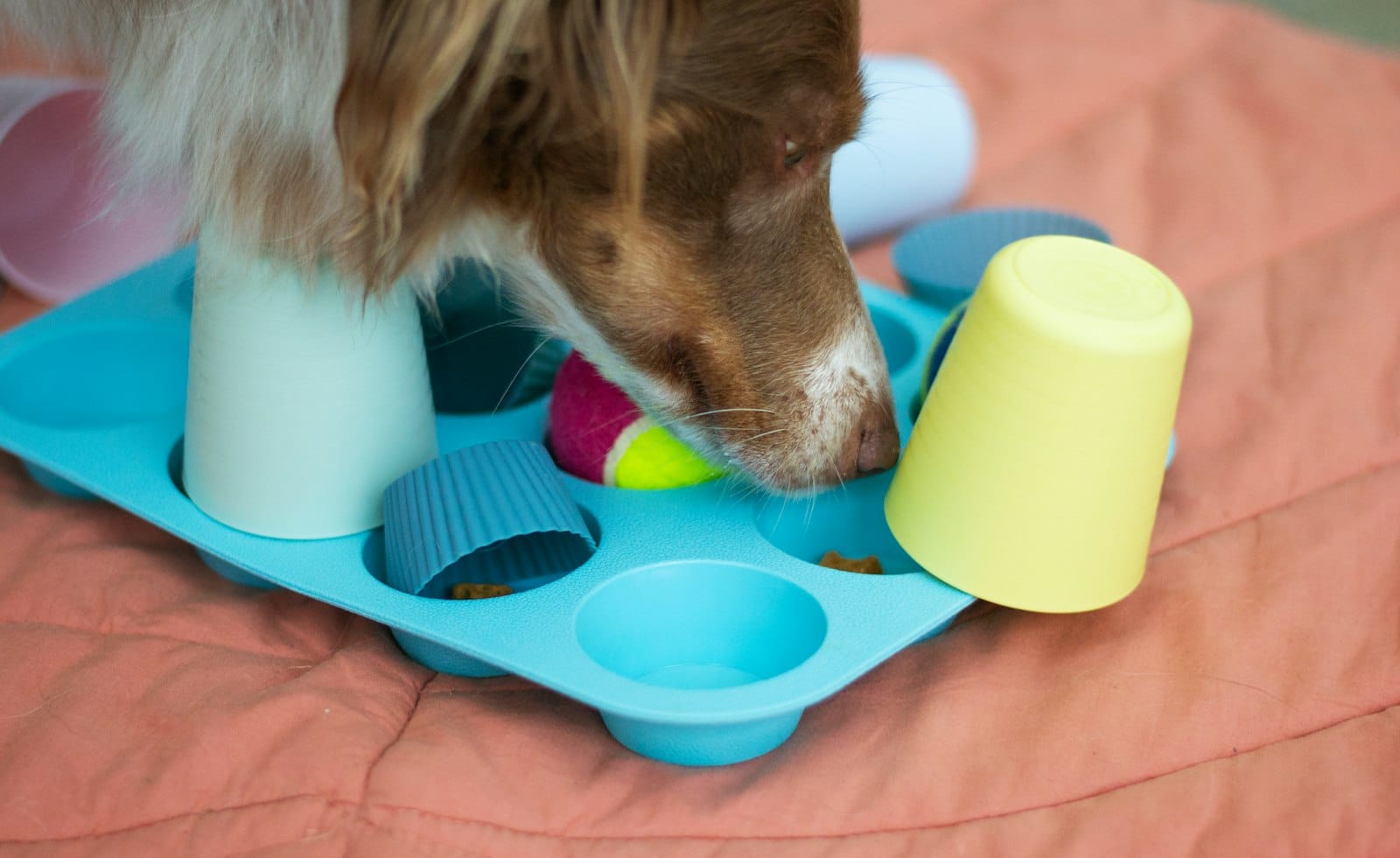
Short days and early darkness do not have to mean a bored dog. The best indoor dog games need no special gear, take ten minutes and use things you already own: a muffin tin, a few cups, some treats and a bit of floor space. Here are seven games to rotate through on long evenings, plus tips for keeping them fun for both of you.
1. Hide and seek
This classic is the easiest of all the indoor dog games. Ask your dog to wait in one room, hide somewhere close, then call them to find you and reward them with praise or a treat. The Ontario SPCA suggests starting with a simple, nearby hiding spot and working up to other rooms. If your dog’s “wait” is still shaky, ask someone to hold the lead while you hide.
2. The muffin tin puzzle
Put a few treats or pieces of kibble in some cups of a muffin tin, then cover every cup with a tennis ball or a light plastic cup. Your dog has to nose and nudge the covers aside to find the snacks. It costs nothing and you can make it harder by covering empty cups too. Stay close to watch, and take away any cover your dog starts to chew.
3. The three-cup shell game
Show your dog a treat, put it under one of three upturned cups and shuffle them slowly. Let your dog pick with a nose touch. Go slowly at first, because the goal is a happy “I found it” moment rather than a test. Many dogs love this game once they understand that the smell leads to the prize.
4. A tidy-up trick
Teaching a dog to put toys back in a basket sounds like a stunt, but it is a very practical bit of training. Start by rewarding your dog for picking up a toy, then for carrying it towards the basket, then for dropping it in. Keep sessions to a few minutes and end while your dog is still keen. The same step-by-step approach works for going to a bed on cue.
5. Tug with rules
Tug is a great way to burn off energy, and the Toronto Humane Society recommends using a sturdy rope toy and letting your dog win often so the game stays fun. To finish, swap the toy for a treat and say your “drop it” cue. A game with clear start and stop signals keeps excitement under control and teaches good manners at the same time.
6. Indoor loose-lead practice
Dark evenings are a good time to polish the skills that make outdoor walks easier. Clip on a lead, walk around the house and reward your dog whenever they keep pace with you. Add turns, speed changes and the odd distraction as they improve. A hands-free lead or one clipped to a belt keeps your hands free for treats. If you also walk after sunset, our guide to how to walk a dog in the dark covers visibility and lighting.
7. A sniff trail around the room
Dogs use their noses to explore, so a scent trail is a satisfying challenge. Drop small treats along a path that winds around furniture and ends at a bigger reward. Increase the difficulty by hiding treats under a folded towel or behind a cushion. Use tiny pieces so the whole game does not turn into a large meal.
Make every game work better
- Pick a calm room and clear the floor of anything slippery or breakable before you start.
- Keep sessions short, around five to fifteen minutes, and finish before your dog loses interest.
- Adjust the difficulty to your dog’s skill level so they win more often than not.
- Use small, soft treats and keep a few in a pocket so the rewards come quickly.
- Set the mood for the evening with a cosy space; our ideas for a cosier home this autumn work for dogs too.
Where to start
You do not need to try all seven at once. Choose one game tonight, probably hide and seek or the muffin tin puzzle, and see how your dog reacts. Swap in a different game every couple of evenings so things stay fresh. If your dog has any special needs or you are unsure what suits them, ask a vet or a qualified trainer for advice. With a few minutes of effort, the long dark evenings become some of the best playtime of the week.